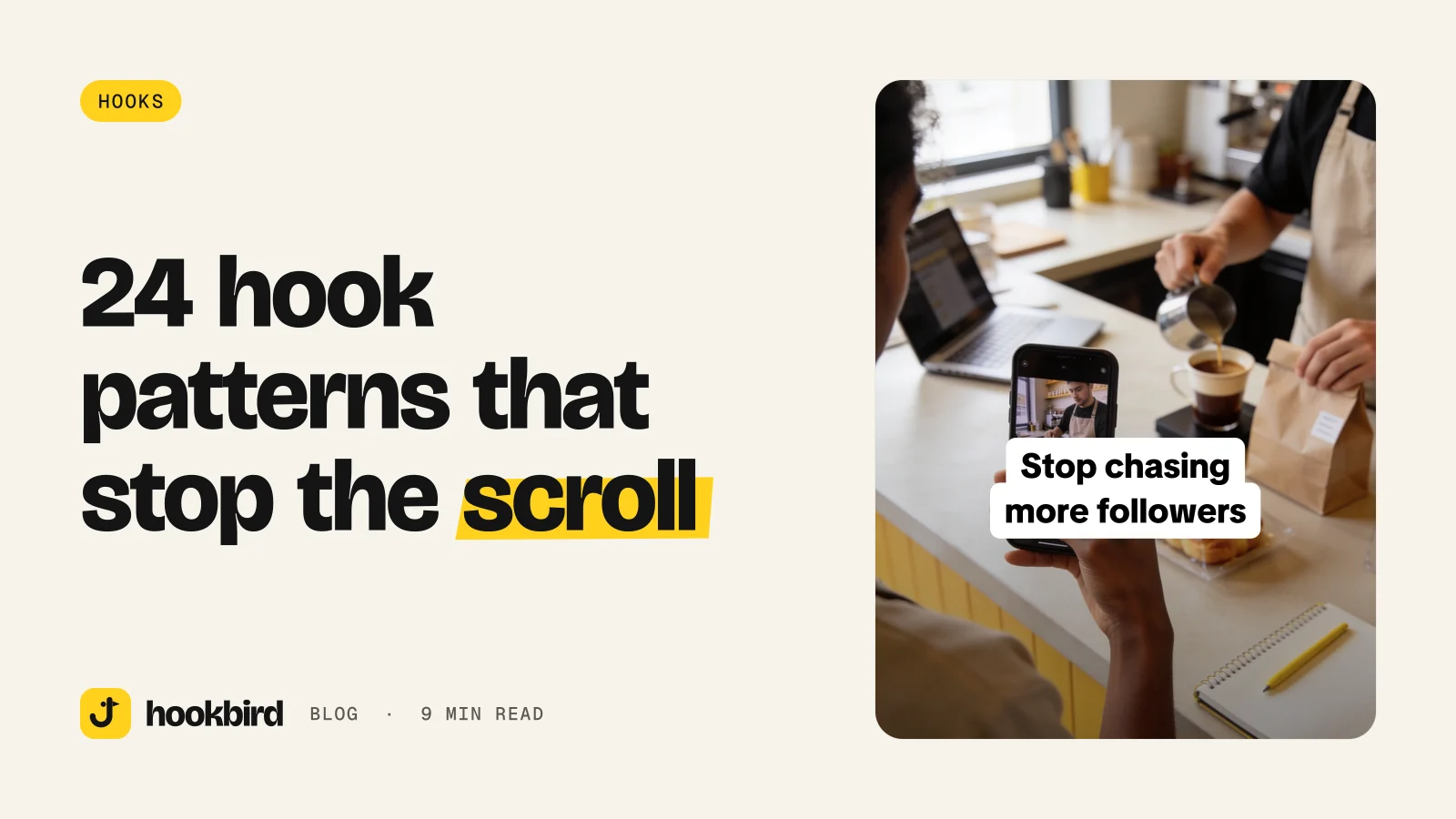
24 hook patterns that stop the scroll
Copy 24 hook patterns for TikTok, Reels, Shorts and carousels, each with a template, a filled example, a backfire note and a simple way to test it.
TL;DR
- 1.Your hook should tell the right person why to keep watching before they feel lost or bored.
- 2.The best pattern depends on the job: call out the viewer, challenge a belief, show proof, open curiosity, name pain, promise an outcome, start a story or use a visual interrupt.
- 3.Each hook needs a backfire check. A strong opening that overpromises will lower trust.
- 4.Test patterns by changing only the opening line, first frame or first slide.
- 5.Keep a hook bank by mechanism so you are not rewriting from a blank page.
On this page
A hook is the part of a post that makes the right person think, “This is for me, and it is worth my time.” It is a writing and editing skill, not a platform trick.
Good hooks do more than sound sharp. They match the viewer, the problem, the proof and the format before the post asks for more time.
What makes a hook work?
Short-form feeds give people many reasons to move on. Your first line, first frame and first slide have to work together.
TikTok’s own ad guidance says to “introduce your content proposition in the first 3 seconds” and to put your hook in the first 6 seconds, according to TikTok Ads Help. The same logic holds for organic posts.
A hook is not only the first sentence
A hook can be the spoken opening line, on-screen text, slide one of a carousel, a thumbnail-style frame, the first visual action or the first visible caption sentence.
The first frame has a job too
Pause on the first frame. If a stranger can answer “who is this for?” and “why should I care?”, the hook is doing its job.
Choose the right hook pattern before you write
The mechanism matters more than the wording. Before writing, ask what the viewer must feel first: seen, surprised, reassured, curious, understood, motivated, pulled into a story or stopped by the visual.
| Goal | Best mechanisms | Avoid when |
|---|---|---|
| Find the right viewer | Call-out, pain | Your label is broad |
| Change a belief | Contrarian, proof | You only want shock |
| Build trust | Proof, story | The evidence is thin |
| Hold attention | Curiosity, visual | The payoff is weak |
| Create desire | Outcome, visual | The promise is vague |
Hook patterns you can copy
Each pattern below includes a template, a filled example and a backfire note. Copy the structure, not the exact wording.
Call-out hooks
- 01
Call-out · If you’re [person] and [specific situation], this is for you.
If you’re a wedding photographer and inquiries are slowing down, this is for you.
Works because it filters fast. Backfires when the audience label is too broad.
- 02
Call-out · POV: You’re [person] trying to [job] without [resource].
POV: You’re a solo dentist trying to keep Instagram alive without hiring an agency.
Works when the situation is real. Backfires when the POV feels made up.
- 03
Call-out · [Person]s, stop doing [common habit] before [moment].
Pilates studios, stop posting class clips before you fix your first slide.
Works because it creates urgency. Backfires when it sounds bossy without a clear reason.
Contrarian hooks
- 01
Contrarian · Everyone says [common advice]. I’d do [opposite] instead.
Everyone says restaurants need more food photos. I’d post the ordering moment instead.
Works when the opposite view helps. Backfires when it is shock for shock’s sake.
- 02
Contrarian · The problem is not [obvious issue]. It’s [hidden issue].
Your skincare ads are not too plain. Your first line is trying to sell too soon.
Works when you reveal the real cause. Backfires when you dismiss a real problem.
- 03
Contrarian · Stop chasing [popular metric]. Fix [better input].
Stop chasing more followers. Fix the first sentence on your product demos.
Works because it shifts control. Backfires when the viewer does need the thing you dismiss.
Proof hooks
- 01
Proof · Here’s the exact [asset or process] we use for [job].
Here’s the exact tasting-menu checklist our bakery uses before a wedding order.
Works because it offers a concrete asset. Backfires when the asset is generic.
- 02
Proof · Watch [thing] go from [before] to [after].
Watch this messy garage go from storage pile to labeled zones.
Works when the change is visible. Backfires when before and after look too similar.
- 03
Proof · I compared [option A] vs [option B] for [use case].
I compared gel polish vs builder gel for clients who type all day.
Works because it helps a decision. Backfires when the comparison is biased or thin.
Curiosity hooks
- 01
Curiosity · Nobody talks about the [small detail] that changes [result].
Nobody talks about the booking-form question that changes dog grooming appointments.
Works when the detail is useful. Backfires when the reveal is obvious.
- 02
Curiosity · I would never [action] until I check [hidden thing].
I would never buy a used road bike until I check this part.
Works because it creates a checklist moment. Backfires when the hidden thing is not surprising.
- 03
Curiosity · You can tell [problem] by looking at [small signal].
You can tell a candle is tunneling by looking at the first burn.
Works when the signal is reliable. Backfires when it overclaims.
Pain hooks
- 01
Pain · If [annoying symptom] keeps happening, check [cause].
If your sourdough keeps spreading flat, check your shaping tension.
Works because it gives a next step. Backfires when it oversimplifies.
- 02
Pain · The reason [task] feels hard is [specific friction].
The reason meal planning feels hard is you’re choosing recipes before checking your week.
Works when it adds relief. Backfires when it sounds like blame.
- 03
Pain · You don’t need [big solution]. You need [smaller fix].
You don’t need a full closet cleanout. You need a workday outfit rack.
Works because it lowers the bar. Backfires when the big solution is needed.
Outcome hooks
- 01
Outcome · Do this before [moment] so [benefit].
Do this before your puppy’s first walk so the leash doesn’t become a battle.
Works when the benefit is specific. Backfires when it is vague.
- 02
Outcome · Steal this [asset] for [specific goal].
Steal this welcome email for new yoga studio members.
Works when there is a real asset. Backfires when there is nothing to copy.
- 03
Outcome · A simple way to [goal] without [undesired tradeoff].
A simple way to refresh your bedroom without repainting.
Works when the tradeoff is avoided. Backfires when the post still requires it.
Story hooks
- 01
Story · A customer asked me [question]. Here’s what I told them.
A bride asked me if silk flowers look fake. Here’s what I told her.
Works when the question is natural. Backfires when it sounds invented.
- 02
Story · I almost made this [mistake] until [turning point].
I almost chose the cheapest tile grout until my installer showed me this.
Works because it shows learning. Backfires when it feels like a fake confession.
- 03
Story · This [object] has a backstory.
This cracked cutting board has a backstory.
Works when the object is interesting. Backfires when nothing visual pulls us in.
Visual hooks
- 01
Visual · Start with the result, then explain the steps.
A florist opens on the finished bouquet, then rewinds to the stem choices.
Works when the result is striking. Backfires when the result looks ordinary.
- 02
Visual · Start with the wrong way, then stop it on screen.
A trainer shows a messy squat setup, freezes, then fixes one cue.
Works because the fix is visible. Backfires when it mocks the viewer.
- 03
Visual · Start with a close-up mystery, then zoom out.
A jeweler opens on a tiny clasp repair, then shows the full necklace.
Works when the reveal is quick. Backfires when the reveal drags.
Write hooks that do not overpromise
- Name a specific viewer.
- Name a specific situation.
- Give a clear payoff.
- Keep the scope honest.
- Make the body match the opening.
The body must pay off the opening quickly. Avoid fake urgency, fake secrets, fake personal stories and claims the post cannot prove.
Test hook patterns without guessing
- 1
Pick a few mechanisms
Choose from call-out, proof, curiosity, pain, outcome, story, contrarian or visual.
- 2
Write variants for one topic
Keep the offer, format and main point the same.
- 3
Change one variable
Change the hook line, first frame or first slide. Do not change all of them at once.
- 4
Review and bank the winner
Save strong hooks by mechanism, not only by topic.
| Column | What to write |
|---|---|
| Date and format | Where it ran and how it was built |
| Audience segment | Who the hook named or implied |
| Topic and mechanism | What the post was about and how it opened |
| Hook text and first frame | The exact opening |
| Notes | Retention signal, comments, saves, follows and next action |
Read patterns by job. Call-out hooks may bring better-fit comments. Proof hooks may earn saves. Story hooks may get replies. Visual hooks may help demos make sense faster.
Adapt the patterns for each format
For carousels, make slide one carry the full hook. Slide two should prove the swipe was worth it. Avoid tiny text.
For talking-head videos, make the spoken line and on-screen text work together. Do not repeat a long title word for word.
For product demos, start on the action or result. Then add the line that explains why it matters.
How to do this in Hookbird
- 1
Build your hook bank
Paste your website URL into Brand onboarding. Hookbird drafts a brand card, likely competitors, audience segments, content angles and a content plan you can edit.
- 2
Write and score variants
Use Hook Lab to write or generate hooks from your brand and angles. You can see the pattern, what works, what to fix and an estimated percentile against your niche, then use one-click rewrites.
- 3
Turn the hook into a post
Send a chosen hook to Create. You can make a UGC talking head, slideshow with the hook on slide one, wall of text, hook + demo, short video, voiceover, animated story or a supported video style. Each generation shows its credit price before you click.
- 4
Publish and review
Use scheduling to draft, approve and publish from one calendar to supported networks. Use benchmarks and analytics to compare your engagement with your niche median and break results down by format and hook pattern.
Radar can show competitor ads from the Meta Ad Library and other configured ad sources, plus niche and regional trends from TikTok Creative Center. Use Remix to turn an angle into your own post without copying the brand.
Frequently asked questions
What are hook patterns?
Hook patterns are reusable opening structures for posts. They work because they use a mechanism, such as naming the viewer, creating curiosity, showing proof or starting with a visual interrupt.
What is a good hook for TikTok or Reels?
A good hook tells the right viewer why to keep watching right away. It should match the first frame, the spoken line and the payoff in the rest of the video.
How do you write a hook for a carousel post?
Make slide one carry the full promise, not just a cute title. Slide two should prove the post is worth swiping by showing the first tip, mistake, example or before-after detail.
How many hook variations should I test?
Start with a few mechanisms and write hooks for the same topic. Keep the format and body similar so you can learn from the opening, not from a pile of unrelated changes.