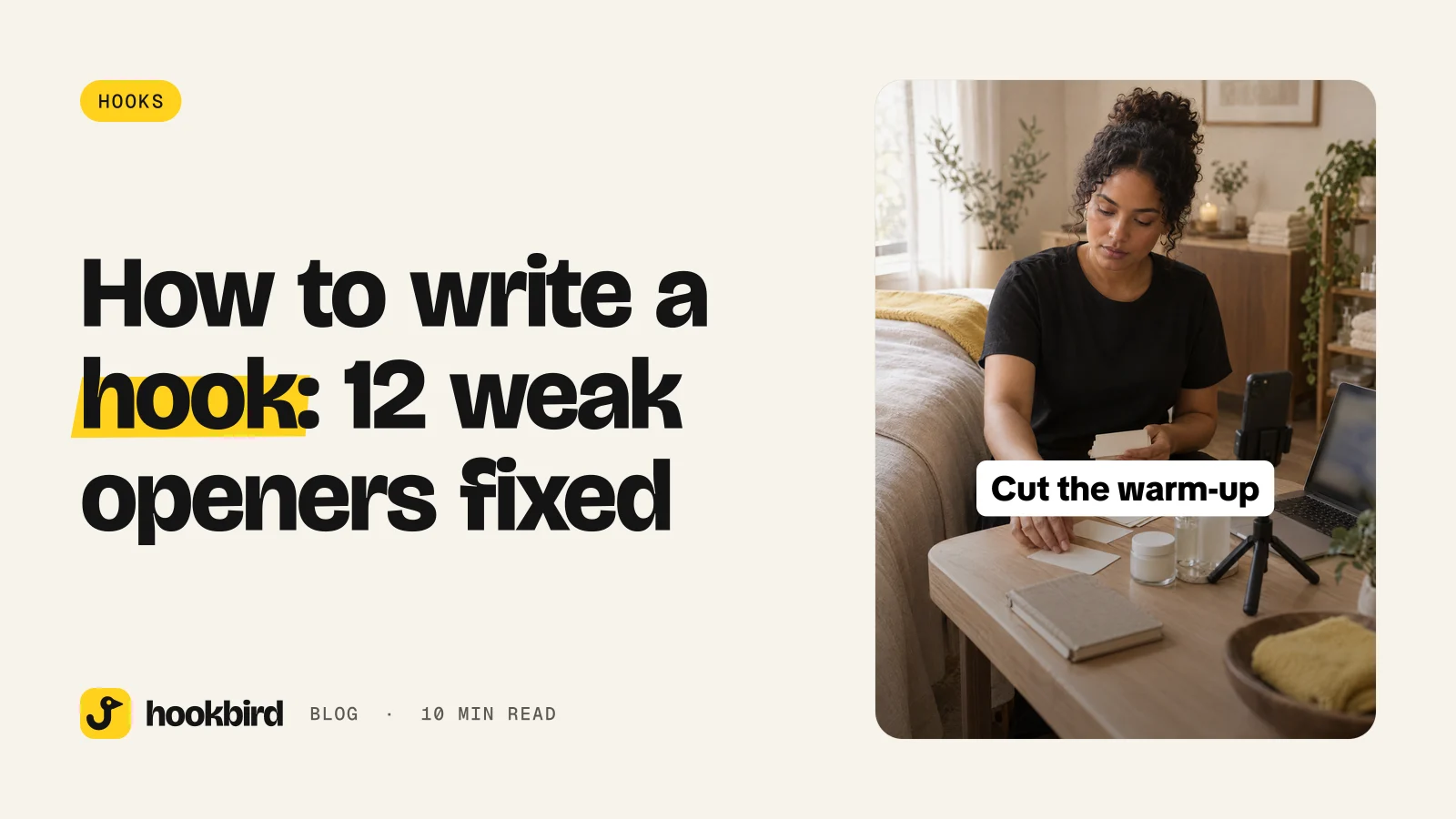
How to write a hook: 12 weak openers fixed
Learn how to write a hook by fixing 12 weak openers with clear edits, copyable templates, and a quick checklist.
TL;DR
- 1.A hook is usually the first sentence. Its job is to make the right person keep reading or watching.
- 2.Weak hooks start too far from the payoff. They greet, explain, or lead with the brand before the viewer cares.
- 3.The fastest fixes are simple: cut the warm-up, name the viewer, move the payoff forward, add proof, or turn a claim into a choice.
- 4.Use numbers only when you can prove them from your own product, process, price, inventory, timeline, or a named source.
- 5.Rewrite the hook before you rewrite the whole post. A better opening often changes the format that follows.
On this page
To learn how to write a hook, start with the edit. Take the weak first line, find the slow part, then move the useful point to the front.
A strong hook does not need to be loud. It needs to make the right person think, “This is for me, and I want the next line.”
What does a hook need to do?
A hook is the opening line that gives someone a reason to keep watching, reading, or swiping. In writing, a hook is an opening statement, usually the first sentence, that tries to grab attention so people want to read on, according to ESU.
On social, the hook can be spoken. It can be written on screen. It can be slide one of a carousel, or the first visual in a short video.
The hook is not the whole post. It opens the loop. The rest of the post must close it.
A useful guardrail from college writing still applies: the hook should take less than half of the introduction, leaving room for the main idea, according to Las Positas College. For social posts, that means the first line should not swallow the message.
Why weak hooks fail
Weak hooks usually fail because they start too far away from the payoff. They greet, explain, label the topic, or lead with the brand before the viewer has a reason to care.
| Weak opener type | What it sounds like | Edit to try |
|---|---|---|
| Warm-up line | “Welcome back to our page.” | Cut it and start with the useful point. |
| Topic label | “Today I want to talk about skincare.” | Name the viewer’s problem instead. |
| Brand-first news | “We’re excited to announce...” | Lead with what changes for the buyer. |
| Vague promise | “Here are some tips.” | Name the exact situation or mistake. |
| Soft question | “Did you know we offer this?” | Show the better decision. |
| Claim with no proof | “This is the best product.” | Make it a choice or add proof you can show. |
If the hook could fit any business, it is probably too broad. “You need this” could sell a candle, a tax app, or a dentist visit.
Search your drafts for lines like “Today I want to talk about,” “We’re excited to announce,” “Here are some tips,” “Did you know,” and “Check this out.” They are not always wrong, but they often hide the real hook one line later.
Do not rewrite the whole post first. Rewrite the first line. A cleaner hook often tells you whether the post should be a demo, list, slideshow, story, or comparison.
The edits used in the rewrites
- Cut the warm-up. Remove greetings, context, and setup before the real point.
- Name the viewer. Say who the post is for: new dog owner, restaurant manager, bride planning a fall wedding, or solo consultant.
- Move the payoff forward. Put the best result, mistake, contrast, or decision in the first line.
- Add a number you can prove. Use your own price, time, stock count, steps, ingredients, wait time, or deadline when it is true and useful.
- Turn the claim into a choice. Replace “best,” “must-have,” or “amazing” with a tradeoff, like Option A vs Option B.
- Make it visual. Add an object, place, screen, dish, room, outfit, invoice, shelf, tool, or customer moment the viewer can picture.
12 before-and-after hook edits you can copy
Use these as editing patterns, not scripts to copy word for word. Swap the bracketed parts for your buyer, product, service, proof, or moment.
- 01
Cut the warm-up · **Cut the warm-up:** [If you run a business type], stop posting [common post] until you fix [specific issue].
If you run a bakery, stop posting cake photos until your caption says the pickup date.
Weak: “Welcome back to our page.” This works because it names the reader and the mistake.
- 02
Name the problem · **Name the problem:** Your [skin concern] routine may be failing because of [specific habit or product step].
Your dry skin routine may be failing because you apply oil before moisturizer.
Weak: “Today I want to talk about skincare.” This moves from topic to pain.
- 03
Move the sensory payoff forward · **Move the sensory payoff forward:** The [dish] is back, and the best bite is the [crunchy, salty, spicy, or sweet detail].
The fish taco is back, and the best bite is the pickled onion crunch.
Weak: “We have a new menu item.” This gives people something to taste in their head.
- 04
Name the exact moment · **Name the exact moment:** [Audience]: check [bill, receipt, booking, or quote] before you pay for [thing].
First-time renters: check the cleaning fee before you book the cabin.
Weak: “Here are some tips for saving money.” The hook points to a moment of action.
- 05
Replace the claim with a pain · **Replace the claim with a pain:** If [task] still lives in [tool], your team can miss [handoff, approval, or deadline].
If client edits still live in email, your team can miss the final approval.
Weak: “Our software helps teams manage projects better.” This shows the cost of the old way.
- 06
Add contrast and a constraint · **Add contrast and a constraint:** This [room, shelf, outfit, profile, or page] went from [before state] to [after state] using only [constraint].
This pantry went from snack pile to labeled shelves using only clear bins.
Weak: “Watch this transformation.” Contrast creates curiosity. The constraint makes it believable.
- 07
Make the use case specific · **Make the use case specific:** Do this when [body cue or situation], not when [common wrong time].
Do this stretch when your hips feel tight after sitting, not right before heavy squats.
Weak: “You need to try this workout.” This helps the right viewer self-select.
- 08
Lead with the payoff · **Lead with the payoff:** The easiest way to make [coffee style] taste less [bitter, watery, burnt, or weak].
The easiest way to make cold brew taste less watery.
Weak: “Let’s make coffee.” This starts with the desired change.
- 09
Behind the scenes · **Turn process into behind the scenes:** This is what happens after you click buy at a [shop type].
This is what happens after you click buy at a handmade candle shop.
Weak: “I’m going to show you how we pack an order.” This frames a plain process as access.
- 10
Better first step · **Show the better first step:** [Audience] usually ask for [service], but need [better first step] first.
New homeowners usually ask for paint colors, but need a lighting plan first.
Weak: “Did you know we offer color consults?” This teaches buyers how to buy smarter.
- 11
Choice · **Turn a claim into a choice:** I’d pick [Option A] over [Option B] if you care about [buyer priority].
I’d pick quartz over marble if you care about low-maintenance counters.
Weak: “This is the best countertop.” A choice feels useful because it depends on a priority.
- 12
Clear action · **Make the next step clear:** If you can [skill] and hate [bad industry norm], read this before [date or next step].
If you can run a busy brunch shift and hate chaos, read this before Friday.
Weak: “We’re hiring.” This names the right candidate and action.
How to write a hook from a weak draft
The rewrite checklist
- 1
Start plain
Write the boring opener first if that gets the idea out. Bad drafts are easier to edit than blank pages.
- 2
Underline the first useful noun
Look for the buyer, product, pain, mistake, place, tool, or result. That is often your real starting point.
- 3
Ask who needs it most
If a clear group needs the message, put them in the first line. “New dog owners” is more useful than “everyone.”
- 4
Ask what changes after they watch
Move the result, decision, warning, or lesson into the hook. Do not save the payoff for the end unless the format needs suspense.
- 5
Ask what you can prove
Add a real number only when it comes from your own business, process, price, stock, timeline, or a named source.
- 6
Delete empty intro phrases
Cut “I just wanted to,” “quick reminder,” “let’s talk about,” and any setup that does not change the meaning.
- 7
Swap vague words
Replace “better” with a specific result, “easy” with a step, and “affordable” with a price or comparison when true.
- 8
Read it alone
The hook should make sense without the rest of the post. It should also create a reason to continue.
A fill-in hook worksheet
- Who is this for? [specific buyer or viewer]
- What are they trying to do? [job, decision, goal, or task]
- What gets in the way? [mistake, cost, delay, confusion, habit]
- What can you show? [object, screen, room, dish, quote, order, tool, shelf]
- What changes after the post? [decision, step, warning, answer, next move]
What not to do when adding proof
Do not invent a stat because the hook feels flat. A false number may get attention, but it also sets up a trust problem you cannot fix with better editing.
Use your own proof instead: steps, minutes, price, stock count, appointments left, ingredients, delivery window, or before-and-after detail. These are often stronger because they come from your real work.
If you use a statistic hook, explain what the number means after the hook; ESU says a statistic hook uses numbers, decimals, or percentages, and its relationship to the main idea should be explained afterward, according to ESU. Do not drop a big number and make the viewer guess why it matters.
Avoid huge claims like “This will change your life.” Use a smaller claim someone can believe: “This helps when [specific situation].”
How to do this in Hookbird
- 1
Build your brand card
Paste your website URL into brand onboarding. Hookbird drafts a brand card, likely competitors, audience segments, content angles, and a content plan you can edit.
- 2
Score the weak hook
Paste your draft into Hook Lab. You get a score, the pattern it uses, what works, what to fix, and an estimated percentile against your niche.
- 3
Try rewrites, then pick a format
Use one-click rewrites or generate hooks from your brand and angles. Send a hook to Create and choose from formats like UGC talking head, slideshow, wall of text, hook + demo, short video, voiceover, or image formats. You see the credit price before you click.
- 4
Check patterns after publishing
Use benchmarks and analytics to see results by format and hook pattern, with each benchmark source labeled.
Frequently asked questions
What is a hook in writing?
A hook is the opening line that gives someone a reason to keep reading. It is usually the first sentence, but on social it can also be the first spoken line, the text on screen, slide one, or the first visual.
How do you write a good hook for social media?
Start with a plain draft, then move the most useful part to the front. Name the viewer, show the problem, add a visual detail, or turn a broad claim into a clear choice. Keep the promise tight so the post pays it off.
What are examples of strong hooks?
Strong hooks sound specific: “First-time renters: check the cleaning fee before you book the cabin,” or “I’d pick quartz over marble if you care about low-maintenance counters.” They work because the buyer, moment, and payoff are clear.
How long should a hook be?
Keep it as short as the idea allows. One clear sentence is often enough. If the hook needs a long setup, the real hook is probably later in the draft.