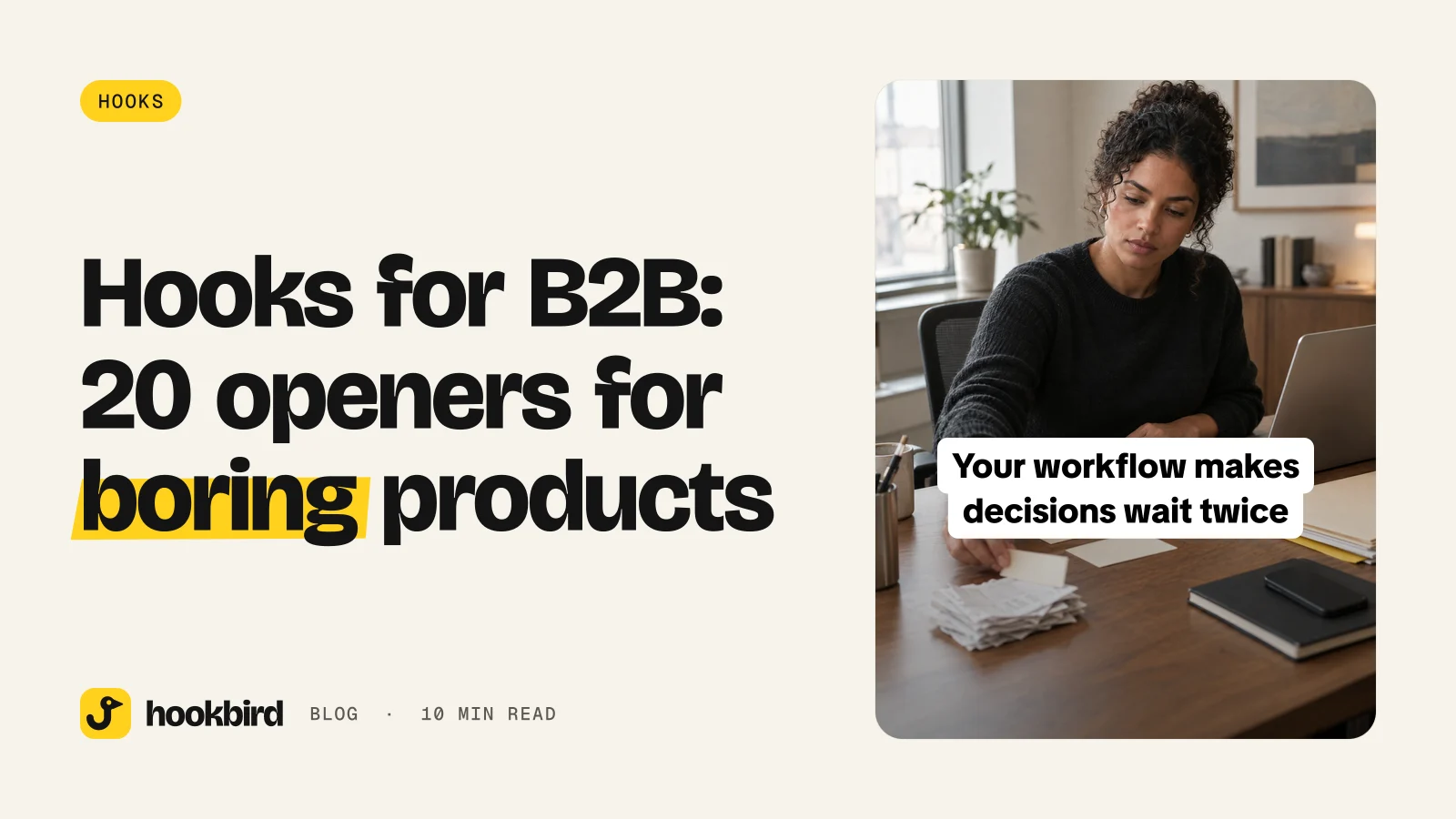
Hooks for B2B: 20 openers for boring products
Copy B2B hook templates for accounting, insurance, logistics, compliance and software, with edits for posts, reels and ads.
TL;DR
- 1.Start with the hidden cost, not the product name.
- 2.Use the buyer’s real fear: delay, rework, fines, churn, stockouts, audit stress or wasted headcount.
- 3.Turn one idea into a cost hook, mistake hook, confession hook and visual comparison.
- 4.Specific details make a hook feel more credible when they are true to your business and customer.
- 5.The best boring-product hooks sound like a smart coworker pointing at a problem everyone has ignored.
On this page
The best hooks for B2B do not make a dull product sound exciting. They make an ignored problem feel visible.
If you sell accounting, insurance, logistics, compliance or software, start with stakes. Money left open. Risk ignored. Work repeated. Trust lost. Decisions delayed.
Why do boring products need different hooks?
Most people do not stop scrolling because they want a post about payroll, renewals, freight updates or audit logs. They stop when the first line sounds like a problem already sitting on their desk.
So do not sell the category first. Sell the pain of ignoring it. Your opener has one job: make the buyer think, “That might be happening here.”
- 01
Category-first
Category-first: “Need help with payroll?
This asks for interest before it creates any.
- 02
Category-first
Category-first: “Looking for better compliance software?
This names your market, not the buyer’s pain.
- 03
Pain-first
Pain-first: “Your payroll problem usually shows up one pay cycle after the mistake.
This gives the buyer a moment they can picture.
- 04
Pain-first
Pain-first: “Compliance does not break on audit day. It breaks when proof gets stored in five places.
This points at the system behind the visible event.
What makes a hook work when the product is not fun?
The 4 hook angles
- Cost of inaction: show what gets worse when the buyer delays.
- Mistake hook: point to a common fix that creates more work or risk.
- Insider confession: say what the category expert notices that buyers miss.
- Visual comparison: compare the hidden problem to something obvious and easy to picture.
The specificity test
Replace vague words with real signals. “Inefficient” is soft. “Manual invoice chase,” “expired certificate,” “missed renewal,” “late shipment update” or “spreadsheet approval chain” gives the buyer something to check.
Specific details can add credibility and intrigue; Strategy Kiln gives the example “In 2025, I interviewed 100 CFOs about remote work – here’s what shocked me,” according to Strategy Kiln.
The first thing we fixed was…,” according to Strategy Kiln. The numbers work because they are tied to a clear business outcome.
Which 20 openers can you copy for B2B posts?
Replace every bracket with a job title, workflow, risk, cost or signal from customer calls. If you cannot hear a buyer saying it, rewrite it.
- 01
Cost of inaction · Cost of inaction: “The most expensive [problem] is the one your team has learned to work around.”
The most expensive late invoice is the one your finance team has learned to chase every week.
It frames the workaround as the cost.
- 02
Cost of inaction · Cost of inaction: “If [process] feels fine, check what happens after [handoff].”
If onboarding feels fine, check what happens after sales hands the account to success.
It points to the messy middle.
- 03
Cost of inaction · Cost of inaction: “Your [team] is not slow. Your [workflow] is making every decision wait twice.”
Your claims team is not slow. Your approval workflow is making every decision wait twice.
It protects the team while blaming the system.
- 04
Cost of inaction · Cost of inaction: “The real cost of [task] is not the fee. It is the cleanup.”
The real cost of payroll is not the fee. It is the cleanup after bad inputs.
It shifts attention from price to afterwork.
- 05
Cost of inaction · Cost of inaction: “Nobody budgets for [risk] until it lands in [department].”
Nobody budgets for certificate mistakes until they land in legal.
It makes risk concrete.
- 06
Mistake hook · Mistake hook: “The mistake most [industry] teams make with [process]: they fix the symptom and keep the bottleneck.”
The mistake most agencies make with invoicing: they fix the reminder and keep the approval bottleneck.
It names a false fix.
- 07
Mistake hook · Mistake hook: “If your answer to [problem] is another spreadsheet, this is for you.”
If your answer to renewal tracking is another spreadsheet, this is for you.
It calls out a familiar patch.
- 08
Mistake hook · Mistake hook: “Stop measuring [easy metric]. Start asking why [bad outcome] keeps happening.”
Stop measuring quote volume. Start asking why approved quotes keep stalling.
It turns a dashboard into a diagnosis.
- 09
Mistake hook · Mistake hook: “A cheaper [service/tool] gets expensive when it creates [hidden work].”
A cheaper broker gets expensive when it creates renewal cleanup.
It handles price pressure without shaming the buyer.
- 10
Mistake hook · Mistake hook: “Your [policy/process/system] is not broken. It is built for a smaller company.”
Your expense policy is not broken. It is built for a smaller company.
It makes growth the reason for pain.
- 11
Insider confession · Insider confession: “What [experts] check first when something feels off.”
What logistics managers check first when shipment updates start slipping.
It borrows the expert’s eye.
- 12
Insider confession · Insider confession: “I can usually spot a messy [process] from one detail: [signal].”
I can usually spot a messy month-end close from one detail: who owns the final approval.
It gives a diagnostic clue.
- 13
Insider confession · Insider confession: “The quiet red flag in [department] is not [obvious issue]. It is [ignored issue].”
The quiet red flag in compliance is not one failed audit. It is proof living in five places.
It reframes the danger.
- 14
Insider confession · Insider confession: “Most buyers ask us about [feature]. The better question is [business risk].”
Most buyers ask us about dashboards. The better question is who changes the number when it is wrong.
It moves the buyer from feature talk to business pain.
- 15
Insider confession · Insider confession: “The teams with fewer [problems] usually have one boring habit: [habit].”
The teams with fewer renewal fires usually have one boring habit: they review wording before the last week.
It makes discipline interesting.
- 16
Visual comparison · Visual comparison: “Running [process] through email is like using a group chat to run payroll.”
Running vendor approvals through email is like using a group chat to run payroll.
It makes the broken system visible.
- 17
Visual comparison · Visual comparison: “Buying [tool/service] without checking [requirement] is like signing a lease without seeing the roof.”
Buying cyber insurance without checking exclusions is like signing a lease without seeing the roof.
It turns fine print into a picture.
- 18
Visual comparison · Visual comparison: “A manual [approval/reconciliation/renewal] process is a vending machine that sometimes keeps your money.”
A manual reconciliation process is a vending machine that sometimes keeps your money.
It makes delay feel like loss.
- 19
Visual comparison · Visual comparison: “Your [system] should not need a translator every time [team A] talks to [team B].”
Your CRM should not need a translator every time sales talks to finance.
It points at language mismatch.
- 20
Visual comparison · Visual comparison: “If your [workflow] needs a hero every Friday, it is not a workflow.”
If your freight update process needs a hero every Friday, it is not a workflow.
It praises the team while questioning the process.
How do these hooks look by industry?
- Compliance: “The quiet red flag in compliance is not one failed audit. It is proof living in five places.” Follow with a checklist of proof sources to centralize.
- B2B software: “Your CRM is not the problem. The problem is every team using a different definition of ‘qualified.’” Follow with field hygiene and shared definitions.
How do you turn one opener into a sequence?
You can reuse one idea without repeating the same post. Start sharp, add proof or context, then reframe the problem from another angle.
Belkins describes a sequence as “Email step 1 — sharp, specific, personalized,” “Email step 2 — reinforcement with a supporting angle,” and “Email step 3 — reframe with a different hook,” according to Belkins. The same structure can help one social theme become several formats.
- 01
Cost of inaction
Cost of inaction: “Your revenue is not waiting on accounting. It is waiting on approvals nobody owns.
Use this when delay is the core pain.
- 02
Mistake hook
Mistake hook: “If the fix for slow revenue recognition is another approval spreadsheet, this is for you.
Use this when the buyer keeps adding admin.
- 03
Insider confession
Insider confession: “The first thing I check in a slow close is not the report. It is the last approval before the report.
Use this for expert-led posts.
- 04
Visual comparison
Visual comparison: “A manual approval chain is a relay race where nobody knows who has the baton.
Use this when you need a visual first slide or video opener.
| Version | Best fit | Next step |
|---|---|---|
| Cost hook | LinkedIn post or sales email | Explain the delayed outcome. |
| Mistake hook | Retargeting ad or carousel | Show the false fix. |
| Confession hook | Founder post or talking-head video | Teach the diagnostic clue. |
| Visual comparison | Reel, TikTok or slideshow | Make the problem easy to picture. |
How do you edit a B2B hook before posting?
The quick edit
- Can the buyer see themselves in the first line?
- Does it name a real workflow?
- Does it imply a cost, risk or delay?
- Can the rest of the post prove the hook?
- Would your sales team recognize the language? If not, make it plainer.
Before and after examples
- 01
Specific reframe
Before: “Our accounting service helps your team close faster.” After: “The month-end close problem usually starts before the close.
The after version starts with the problem, not the service.
- 02
Claim control
Before: “This one mistake is destroying your business.” After: “This payroll mistake creates cleanup your finance team feels next month.
The after version cuts empty drama and names the cleanup.
- 03
Workflow detail
Before: “We improve compliance workflows.” After: “Your audit prep gets harder when proof lives in inboxes, drives and vendor portals.
The after version gives places the buyer can check.
Use brackets as a drafting habit. Then replace them with buyer language from sales calls, support tickets, onboarding notes and competitor ads.
Do not use numbers unless they come from your own real data or a cited source you can link in the same sentence. Curiosity is fine, but the post must keep the promise made by the first line.
How to do this in Hookbird
- 1
Build the base
Paste your website URL into brand onboarding. Hookbird drafts a brand card, likely competitors, audience segments, content angles and a content plan you can edit.
- 2
Draft and score hooks
Use Hook Lab to write or paste a B2B hook. Review the score, pattern, what works, what to fix and the estimated percentile against your niche. Use one-click rewrites when the opener is too vague.
- 3
Turn the hook into a post
Send a hook to Create and pick the format before spending credits. Options include UGC talking head, slideshow, wall of text, hook + demo, short video, images, voiceover, consistent influencer and animated stories.
- 4
Study, publish and review
Use Radar to study competitor ads from the Meta Ad Library and other configured ad sources, plus TikTok Creative Center trends by niche and region. Then schedule from the composer and calendar, and review benchmarks and analytics by format and hook pattern.
Frequently asked questions
What are the best hooks for B2B content?
The best hooks for B2B content start with a business problem, not the product category. Cost of inaction, mistake, insider confession and visual comparison hooks work well because they point at money, risk, delay or rework.
How do you write hooks for boring products?
Write down the workflow your buyer complains about, then name what gets worse when it is ignored. Replace vague words like “inefficient” with real signals such as missed renewals, late shipment updates or manual invoice chasing.
What is a good hook for accounting or insurance posts?
For accounting, try: “If your answer to late invoices is another reminder email, this is for you.” For insurance, try: “Nobody checks certificate wording until a claim makes every word matter.” Each one should lead into a useful explanation, not a scare tactic.
How many hooks should I test for a B2B ad or post?
Start with one version from each angle: cost, mistake, confession and visual comparison. That gives you contrast without changing the whole message.