Curiosity gap hooks that keep their promise
Use a promise test, examples, and payoff rules to write curiosity gap hooks that earn the next second without clickbait.
TL;DR
- 1.A good curiosity gap withholds the answer, not the topic.
- 2.Clickbait breaks when the payoff is weaker, different, or later than the hook implied.
- 3.Use the promise test: can a viewer name what they will learn, who it is for, and when the answer arrives?
- 4.Write the payoff line before you write the full script.
- 5.The safest curiosity hooks are specific: one mistake, one swap, one test, or one before-and-after.
On this page
Curiosity gap hooks work when the viewer can see the topic, feel one missing piece, and trust that you will answer it soon. The gap is not a trick. It is a promise with one part held back.
The goal is simple. Make someone think, “I need the answer to that.” Then give the answer fast enough that the next hook from your brand still feels safe to trust.
What is a curiosity gap hook?
A curiosity gap hook is an opening that creates a clear unanswered question in the viewer’s mind. It shows the category of the answer before asking the viewer to wait for it.
The viewer should know what they are about to learn. They do not need the full answer yet.
The simple formula
Use this formula: known setup + missing piece + implied payoff.
- Known setup: the topic the viewer already understands.
- Missing piece: the cause, mistake, swap, order, test, or example they do not know yet.
- Implied payoff: what they will be able to fix, judge, or explain after watching.
- 01
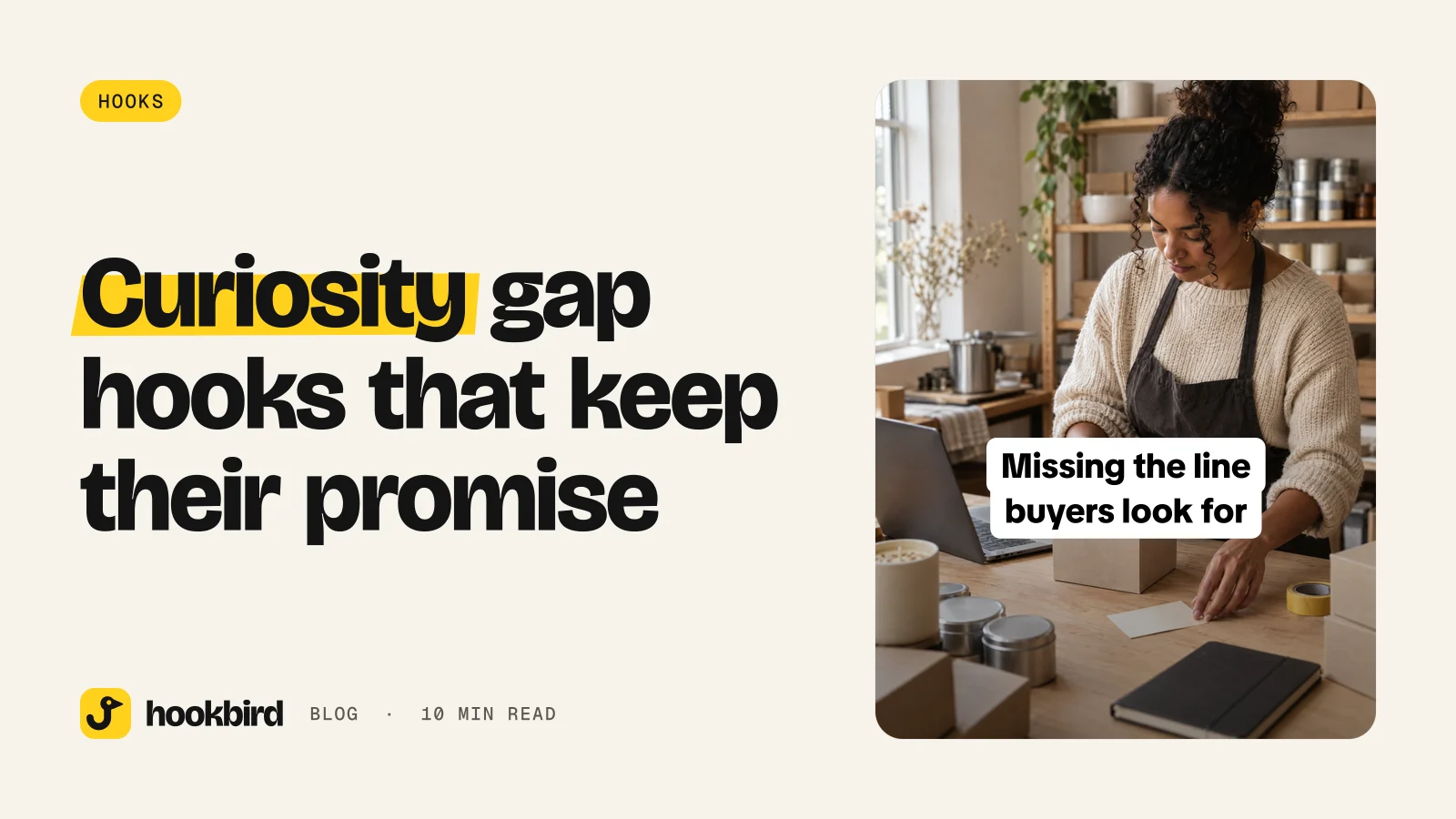
Missing line · Missing line: Your [product page] is missing the one line buyers look for first.
Your candle product page is missing the one line gift buyers look for first.
The topic is clear: a product page. It backfires if you never show the line.
- 02
Wrong order · Wrong order: Your [demo] shows [feature] before [pain].
Your booking demo shows the calendar before the scheduling headache.
It creates a useful question: what should come first? It backfires if the video turns into a full product tour.
- 03
Vague tease
Vague tease: Nobody is talking about this.
This hides the topic, so the viewer cannot judge if the answer is worth waiting for. Use it only if the visual makes the topic obvious.
Mystery is not confusion
Mystery makes the viewer ask the next question. Confusion makes them leave because they do not know what is being offered.
A strong curiosity hook withholds the answer. A weak one withholds the topic.
Why broken promises hurt watch time and trust
A hook sets a contract. It says, “Give me your attention, and I will answer this specific question.”
If the video answers a different question, the viewer feels tricked. Even if they finish once, they may discount your next claim.
YouTube’s audience-retention report uses the “Intro” key moment to show what percentage of your audience are still watching after the first 30 seconds, according to YouTube.
YouTube defines misleading metadata or thumbnails as using the title, thumbnail, description, or tags to trick users into believing the content is something it is not, according to YouTube.
Google says it does not allow preview content that promises a topic or story that is not reflected in the content, according to Google Discover content policies.
The next post pays for this post’s promise
Your audience remembers the feeling of the payoff. If the answer was clear, they are more likely to give the next post a fair chance.
The 3-question test: curiosity gap or clickbait?
Before you post, run the hook through these questions. They catch most broken promises while the script is still easy to fix.
Question 1: Is the topic visible?
Can the viewer tell what the video is about before the reveal? If not, add the topic noun: landing page, menu, demo, pricing page, caption, onboarding email, product photo.
Question 2: Is the payoff exact?
Does the payoff answer the exact question the hook creates? If not, rewrite the hook or rewrite the payoff.
Question 3: Is the answer worth the wait?
Would the payoff still feel useful if the viewer skipped the middle? If not, the hook may be hiding a weak point.
Google’s people-first guidance asks whether the main heading or page title gives a descriptive, helpful summary and avoids exaggeration or shock, according to Google Search Central. That same lens works for short-form hooks.
| Status | Hook | Payoff check |
|---|---|---|
| Pass | Your pricing page hides the sentence that explains why the plan costs more. | Shows the sentence, then rewrites it. |
| Near miss | Your pricing page has a problem no one notices. | Adds “pricing page,” but the problem is still too broad. |
| Fail | This is why nobody buys from you. | The topic is hidden, and the claim is too large. |
How to build a curiosity hook that pays off
Start with one concrete viewer problem. Not “marketing.” Try “our product demo gets likes but no trial signups.”
Then choose the missing piece. Good options are cause, mistake, rule, swap, order, test, example, or before-and-after.
- 1
Name the viewer problem
Viewer problem: [problem]. Example: “Our menu posts do not make people order.”
- 2
Choose the missing piece
Missing piece: [cause/mistake/swap/order/test]. Example: “The photo creates the wrong question.”
- 3
Write the owed payoff
Owed payoff: [one-sentence answer]. Example: “Show the dish with the serving size and pickup detail, not just the close-up.”
- 4
Write the hook
Hook: [hook]. Example: “This pasta photo looks good, but it creates the wrong question.”
- 5
Choose the proof
Proof: [demo/example/screenshot/process]. Example: “Show the original photo, then the revised post.”
Pay it off early
Do not spend the whole opening naming the gap. Show the answer path fast, then use the rest of the post to prove it.
Users often leave web pages in 10–20 seconds, and pages need to communicate value within 10 seconds to earn longer attention, according to Nielsen Norman Group. Short-form viewers also make quick value judgments, so do not make the opening carry more weight than it can hold.
20 curiosity gap hooks with the payoff each one owes
Use this table as a pre-publish checklist. Match the hook to the exact payoff before you record, design, or schedule the post.
| Pattern | Hook template | Best for | Payoff it owes |
|---|---|---|---|
| Hidden cost | The hidden cost in your [process] is [specific area]. | Ops, service, ecommerce | Name the cost and show how to spot it. |
| Wrong order | Here is the order I would use to explain [offer]. | Sales pages, demos | Give the order, not a theory about messaging. |
| Missing line | Your [landing page] is missing the line that tells buyers [why now]. | Landing pages | Show the exact line and where it goes. |
| Small swap | If your [post] starts with [common phrase], try this instead. | Captions, scripts | Show the original and the replacement. |
| Before-after cause | Most [industry] posts fail before the offer appears. | Social posts | Name the opening mistake and rewrite it. |
| Expert check | I would change one thing before running ads to this [product]. | Ad prep | Show the one change, not a full audit. |
| Common fix that fails | The usual fix for [problem] makes [asset] weaker. | Advice posts | Name the common fix and the better move. |
| One rule | One rule I use before posting any [format]. | Checklists | State the rule and apply it once. |
| Unexpected comparison | This [menu/photo/demo] looks fine, but it creates the wrong question. | Visual assets | Name the wrong question and replace it. |
| Teardown | This [page/post/ad] answers the right question in the wrong order. | Audits | Rewrite the sequence. |
| Test | A quick test for whether your [hook] is too vague. | Hooks, ads | Give the test and a pass/fail example. |
| Timing mistake | This [testimonial/review] is good, but you are using it too late. | Proof, sales pages | Show the better placement. |
| Buyer objection | This is why people ask [objection] after seeing your [page/post/ad]. | Offers | Connect one asset to one objection. |
| Pricing clue | The problem is not your [price]; it is the sentence before it. | Pricing pages | Identify the sentence and rewrite it. |
| Setup mistake | Your [demo] shows the feature before the pain. | Product demos | Reorder the demo with the pain first. |
| Proof gap | Before you post another [tip], add this proof. | Education content | Specify the proof type. |
| Shortcut with boundary | One word makes this [offer] feel harder than it is. | Offers, captions | Name the word and replacement. |
| Myth correction | This is the difference between a helpful tease and clickbait. | Content strategy | Compare two hooks and explain the difference. |
| First step | Do not start your [UGC script] with the product yet. | UGC scripts | Show the better first line. |
| Last-mile detail | Here is the boring detail that makes [claim] believable. | Claims, proof posts | Show the detail and why it adds proof. |
- 01
Hidden cost · Hidden cost: The hidden cost in your [process] is [specific area].
The hidden cost in your returns process is the email you send first.
It points to one cost inside one process. It backfires if you make the cost sound larger than you can prove.
- 02
Wrong order · Wrong order: Here is the order I would use to explain [offer].
Here is the order I would use to explain a first-time meal prep box.
The viewer expects a sequence. Do not switch into broad positioning advice.
- 03
Missing line · Missing line: Your [landing page] is missing the line that tells buyers [why now].
Your course page is missing the line that tells buyers why now.
It is specific and easy to pay off. Show the line early.
- 04
Small swap · Small swap: If your [post] starts with [common phrase], try this instead.
If your gym post starts with ‘new class alert,’ try this instead.
It promises one replacement. It backfires when you add five fixes.
- 05
Buyer objection · Buyer objection: This is why people ask [objection] after seeing your [page/post/ad].
This is why people ask ‘is it hard to install?’ after seeing your shelf ad.
It connects content to a real question. It backfires if the objection is guessed and not visible in the asset.
How to do this in Hookbird
- 1
Set the base
Paste your website URL in Brand onboarding. Hookbird drafts a brand card, likely competitors, audience segments, content angles, and a content plan you can edit.
- 2
Check the hook
Write a curiosity gap hook in Hook Lab. You can see the pattern it uses, what works, what to fix, and an estimated percentile against your niche.
- 3
Make it more specific
Use one-click rewrites to tighten a vague hook. Then send the hook to Create when the payoff line is clear.
- 4
Turn it into a post
Use Create for formats such as a UGC talking head, slideshow with the hook on slide one, wall of text, hook + demo, short video, images, voiceover, consistent influencer, or animated story.
- 5
Review what worked
Use Benchmarks and analytics to compare results by format and hook pattern. Each benchmark source is labelled, so you can see what you are comparing against.
Frequently asked questions
What are curiosity gap hooks?
Curiosity gap hooks are openings that create a clear unanswered question. The viewer knows the topic, but one useful piece is missing. A strong one makes the viewer want the answer without hiding what the content is about.
How do you write curiosity hooks without clickbait?
Write the payoff first. Then write a hook that points to that exact answer, not a bigger claim. If the viewer cannot name what they will learn, who it is for, and when the answer arrives, make the hook more specific.
What is the difference between a curiosity gap and clickbait?
A curiosity gap withholds the answer while keeping the topic visible. Clickbait withholds or distorts the topic, then gives a weaker or different payoff. The test is simple: did the content answer the exact question the hook created?
Do curiosity hooks hurt audience retention?
They can hurt retention when the answer comes too late or feels unrelated. They help when the hook creates a fair question and the content pays it off early. Treat the hook like a contract, not a trap.