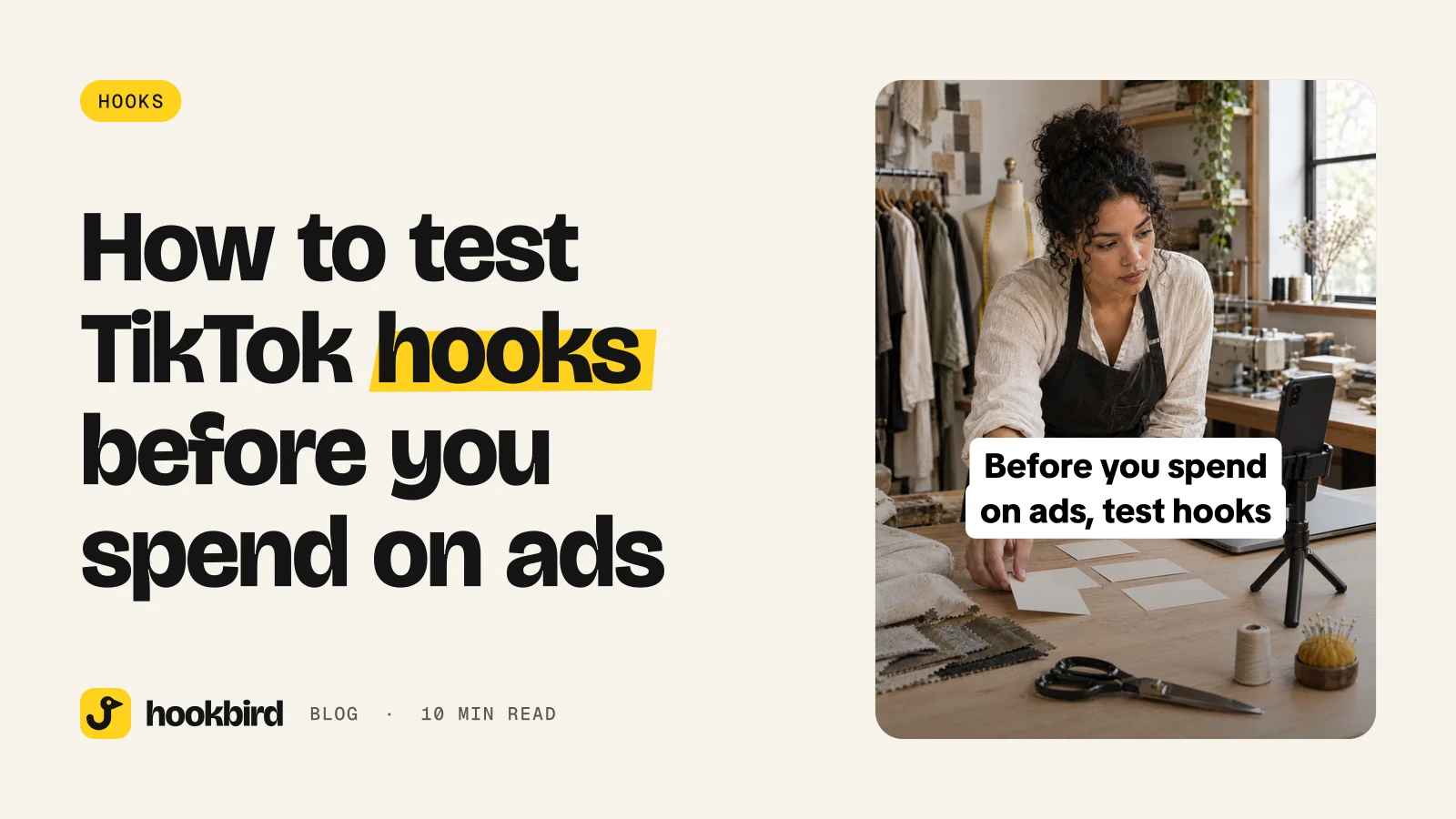
How to test TikTok hooks before you spend on ads
A practical hook testing system for TikTok: isolate the opener, pick the right metrics, screen organically, and keep a simple test log.
TL;DR
- 1.Test the opener only. Keep the body, caption, cover, offer, and posting window as close as possible.
- 2.Judge hooks by early attention first, then watch depth, then quality actions like comments, saves, profile visits, or clicks.
- 3.Use organic posts as the first screen. Move only the best openers into a small paid test.
- 4.Do not crown a winner from one lucky post. Compare hooks only when reach source and viewer count are similar.
- 5.Keep a hook test log so future scripts come from patterns, not guesses.
On this page
- What counts as a clean hook test?
- Which hook variants should you test first?
- How do you run the organic hook screen?
- What metrics should you compare?
- When is the sample big enough to choose a winner?
- How do you confirm with a small ad test?
- What should your hook test log include?
- How to do this in Hookbird
- FAQ
To test TikTok hooks, change the opener and keep the rest of the video as steady as you can. Same body. Same offer. Same caption style. Same audience. Same posting window if possible.
Most bad hook tests compare full videos, not hooks. If the edit, creator, caption, offer, and audience all change at once, you do not know what caused the result.
What counts as a clean hook test?
A hook is the first reason a viewer keeps watching. It can be the first line, first frame, first text overlay, or first visual promise.
A clean test changes one part of that opener. The rest of the video should stay close enough that the opener is the main difference.
The one-variable rule
- Keep the same demo, proof, offer, and call to action.
- Keep the same edit pace, music style, length, and caption style.
- Change one thing: the claim, question, objection, mistake, price point, or visual setup.
- Name the variable before you post. If you cannot name it, the test is messy.
Bad test vs clean test
Which hook variants should you test first?
Start with different angles, not tiny word changes. “Stop doing X” and “Quit doing X” are not a useful first test.
Build your first set from clear hook categories. You want each opener to make a different promise to the same viewer.
Test angles before wording
- Problem hook: names the pain the viewer already feels.
- Mistake hook: points at a common habit that may be costing them.
- Curiosity hook: opens a gap, but does not hide the topic.
- Proof hook: shows a result, demo, or concrete before-and-after.
- Objection hook: answers the reason they are not ready to buy or try.
- Direct offer hook: states the product, deal, or outcome without suspense.
Starter hook set to copy
- 01
Problem · Problem: “Stop doing [common action] if you want [desired result].”
Stop ordering the same lunch if you want more protein under budget.
Works when the action is familiar. It fails when the advice feels bossy or too broad.
- 02
Mistake · Mistake: “The reason [thing] feels hard is not [obvious reason].”
The reason meal prep feels hard is not your schedule.
Gives the viewer a reason to question an old belief. It fails if the video does not reveal the real cause fast.
- 03
Objection · Objection: “I would not buy [product type] until I checked [specific detail].”
I would not buy a tinted sunscreen until I checked the finish in daylight.
Works for products with comparison shopping. It fails if the detail is not specific enough to help.
- 04
Direct offer · Direct offer: “Before you spend [money/time] on [solution], watch this.”
Before you spend Saturday cleaning your patio, watch this.
Catches buyers near a decision. It fails if the opener sounds like a trick and the offer is weak.
- 05
Proof · Proof: “Here is [specific thing] before and after [process].”
Here is our lunch rush before and after the new pickup shelf.
Works when the visual proof is clear. It fails when the change is hard to see.
- 06
Curiosity · Curiosity: “Most people miss [specific detail] when they choose [product].”
Most people miss the seam when they choose a sofa.
Opens a clear gap. It fails if the detail is not shown or explained.
Near-duplicates come later. First find the angle that earns attention and useful actions. Then test tighter wording inside that angle.
How do you run the organic hook screen?
Use organic posts as the first screen. You are not trying to prove the final ad winner. You are trying to avoid paying for weak openers.
- 1
Duplicate the body first
Start with the same video body, slideshow, or demo. If the platform lets you duplicate a draft, duplicate it before changing the opener.
- 2
Swap only the opener
Change the first line, first frame, or first slide headline. Keep captions, hashtags, cover text, call to action, and length as close as possible.
- 3
Space the posts
Post the versions far enough apart that they do not fight each other in the same short window. Use the same account and similar posting windows.
- 4
Let weak versions breathe
Do not delete a slow start too fast. Early data can move as the post reaches more viewers.
- 5
Write the rule before posting
For example: promote the hook that gets the best early hold and does not lose quality actions.
What metrics should you compare?
Judge in this order: early attention, watch depth, then quality actions. Views alone are a weak judge because reach can be shaped by timing, audience, and platform tests.
| Metric group | What to look at | How to use it |
|---|---|---|
| Early attention | Hold rate, thumb-stop rate, or the closest early-retention metric | Use this first. If the opener cannot earn the next few seconds, the rest of the video gets a weak chance. |
| Depth | Average watch time, completion rate, replays, or quartile retention | Use this to break ties. Google Ads video reporting includes quartiles that show how often a video ad plays to 25%, 50%, 75%, or 100% of its length, according to Google. |
| Longer-video intro hold | The share of viewers still watching after the opening section | For longer videos, YouTube’s audience retention “Intro” key moment shows what percentage of your audience is still watching after the first 30 seconds, according to YouTube. |
| Quality actions | Comments that mention the offer, saves, shares, profile visits, link clicks, add-to-carts, or leads | Use this to block false winners. A hook that gets curiosity but no useful action may not be your ad opener. |
A simple scoring rule helps. Early attention wins the first pass. Completion breaks ties. Quality action blocks a hook that attracts the wrong viewer.
When is the sample big enough to choose a winner?
Do not fake precision. A small account can test hooks, but the answer may be “keep testing,” not “scale this now.”
Plain-English sample rules
- Each hook should have a similar number of starts before you compare.
- Reach source should be similar. Do not compare one version that reached mostly followers with another that reached a broad audience.
- Give each post time to move past the first burst of distribution.
- If results are close, call it a tie and test a bigger contrast next time.
- If one hook wins attention but loses quality actions, tag it as high curiosity, low buyer intent.
Decision labels
| Label | Use it when | Next move |
|---|---|---|
| Winner | One hook leads on early attention and does not lose quality actions | Move it to a small paid test or use the pattern again. |
| Tie | Results are close or reach sources differ | Run a sharper angle test. |
| Reject | The hook loses attention or attracts the wrong actions | Save the note, then stop using that opener for this offer. |
How do you confirm with a small ad test?
Only move your best organic hooks into paid testing. Do not pay to test every rough idea.
- 1
Build matched ad variants
Use the same creative body and landing page for each version. Change only the opener.
- 2
Keep the ad settings steady
Use the same audience, placement set, optimization goal, and budget style across variants.
- 3
Read attention before cost
Check early retention and watch depth before cost metrics. A weak opener can make the rest of the ad hard to judge.
- 4
Pause clear losers
Stop variants that clearly lose attention. Spend the next test on a sharper contrast, not a tiny rewrite.
Paid results confirm direction. They do not prove a hook is perfect. Your goal is to find the opener that deserves the next round of spend.
What should your hook test log include?
Your log turns each test into an asset. Without it, you keep starting from taste and memory.
Copyable log columns
Use these columns: test name, date, product or offer, audience, format, body creative ID, hook text, hook pattern, variable changed, posting window, reach source, starts, early-retention metric, hold rate, average watch time, completion rate, saves, comments, clicks or profile visits, notes, decision, next test.
Example rows
| Business | Hook text | Pattern | Variable changed | Decision note |
|---|---|---|---|---|
| Local restaurant | “Before you order [usual lunch item], check the [new special].” | Direct offer | Opening offer frame | Use if comments ask about pickup, menu, or hours. |
| Skincare brand | “I would not buy [product type] until I checked [specific ingredient or finish].” | Objection | First line | Tag high intent if viewers ask fit questions, shade questions, or routine questions. |
| B2B software demo | “Stop tracking [workflow] in [manual tool] if you want [team outcome].” | Problem | Opening pain | Use if viewers mention the workflow, not just the phrasing. |
How to read the notes
Write why you think the hook won or lost before reading comments. Then update the note after you read them. This keeps you from rewriting history around one loud comment.
When a hook wins, save the pattern, exact opener, offer, format, and audience. When it gets attention but weak buying signals, tag it as a false positive, such as “high curiosity, low buyer intent.”
How to do this in Hookbird
- 1
Set the base strategy
Paste your website URL into Brand onboarding. Hookbird drafts a brand card, likely competitors, audience segments, content angles, and a content plan you can edit.
- 2
Build and score hook options
Use Hook Lab to generate hooks from your brand and angles. Score each hook, see the pattern it uses, review what works and what to fix, and use one-click rewrites when needed.
- 3
Create matched variants
Send chosen hooks to Create. Keep the body consistent across formats such as UGC talking head, slideshow, wall of text, hook + demo, short video, or other available styles. Each format shows its credit price before you click.
- 4
Schedule and compare
Use the composer and calendar to place versions across TikTok, Instagram, YouTube, LinkedIn, X, Facebook, Threads, Pinterest, Bluesky, and other networks. Use drafts and preview links for approval. Then use benchmarks and analytics to compare results by format and hook pattern. Use Radar to study ad angles and remix an angle into your own post without copying it.
Frequently asked questions
How do you test TikTok hooks without paid ads?
Post the same video body with different openers as separate organic versions. Keep the caption, cover, offer, length, and posting window as close as possible. Pick a decision rule before posting, then compare early attention and quality actions.
What is a good metric for testing a TikTok hook?
Start with an early-attention metric, such as hold rate or the platform’s closest early-retention metric. Then check completion or average watch time. Use comments, saves, profile visits, or clicks to make sure the hook attracts the right viewer.
How many views do you need before picking a winning hook?
There is no clean universal number. Compare hooks only when they have a similar number of starts, similar reach source, and enough time past the first burst of distribution. If the results are close, call it a tie and test a bigger contrast.
Should you test different hooks with the same video or make new videos?
Use the same video when you are testing hooks. If you make a new video, you are also testing the edit, creator, proof, offer, and pacing. Once you find a strong hook angle, you can test new creative bodies around it.